
Buying the right air conditioner is about matching the unit’s cooling capacity to the specific thermal load of your room. You must calculate the correct size to ensure efficiency, comfort and low running costs, as guessing often leads to expensive mistakes.
If you get the size wrong, the results are immediately noticeable. An undersized unit will run constantly to reach the target temperature, causing electricity bills to surge without ever effectively cooling the space. In the opposite scenario, an oversized unit will cool the room too quickly and shut off before removing moisture from the air. This “short-cycling” leaves you with a cold but damp room and puts unnecessary stress on the system components, leading to premature wear and tear.
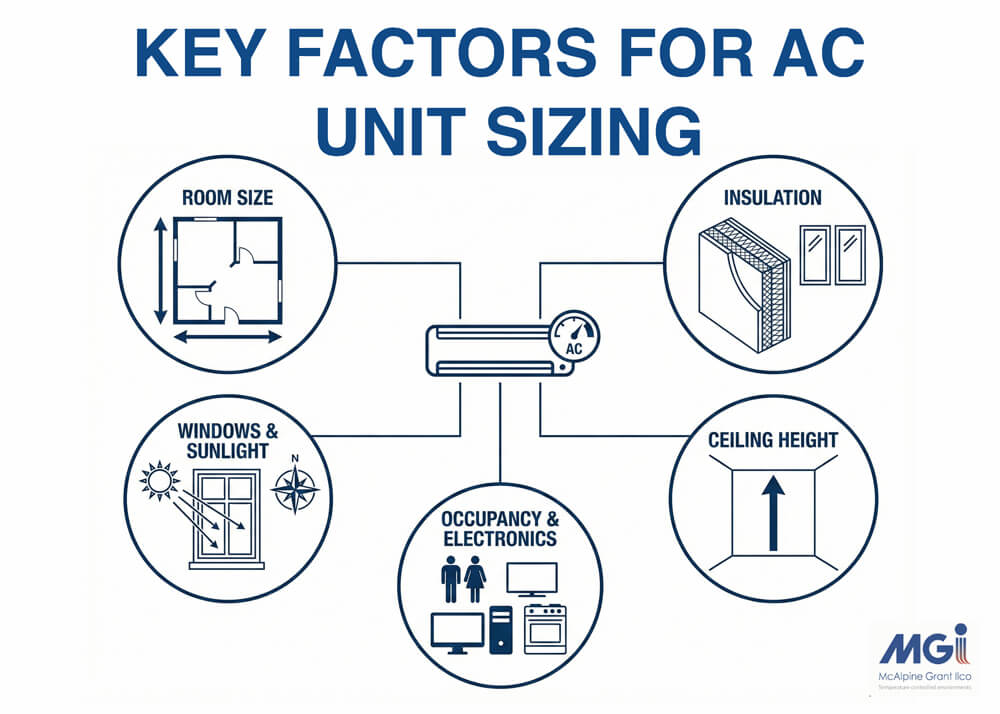
Factors that determine what size AC unit you need
While floor area provides the baseline for your calculation, several environmental factors will increase or decrease the amount of power required. You must adjust your final kW or BTU calculation based on these variables to get an accurate match for your home.
Room Size
The physical dimensions of the space are the starting point for any sizing calculation. You need to measure the length and width of the room in metres to find the total square footage or square metres. If you are cooling two rooms connected by an open archway or door, you must combine the dimensions of both spaces.
Insulation
The quality of your home’s insulation dictates how well it holds cold air. If you live in a property with modern cavity wall insulation and double glazing, you can stick to the lower end of the power range. However, for older properties with single-glazed sash windows or poor wall insulation, you should increase the required capacity by approximately 15–20% to account for thermal loss.
Windows and sunlight
Direct sunlight acts as a massive heat source that your air conditioner must counteract. If your room has large, south-facing windows or bi-fold doors, the space becomes a heat trap, and you should add 10–15% to your cooling requirement. Conversely, if the room is heavily shaded or north-facing, you can often reduce the required capacity by 10%.
Ceiling height
Standard sizing charts assume a typical ceiling height of 2.4 to 3 metres. If you have high ceilings or a loft conversion, there is a larger volume of air to cool. In these cases, you should add roughly 10% more power for every extra metre of ceiling height to ensure the unit can circulate air effectively throughout the entire volume.
Occupancy and electronics
Every person and electrical appliance in a room generates heat, acting like a mini-radiator. If more than two people frequently occupy the room, you should add roughly 600 BTU (or 0.1 kW) for every additional person. You must also account for heat-generating electronics; a kitchen with an oven may require an extra 4,000 BTU, while a room with a high-performance gaming PC or large TV will also increase the cooling load.
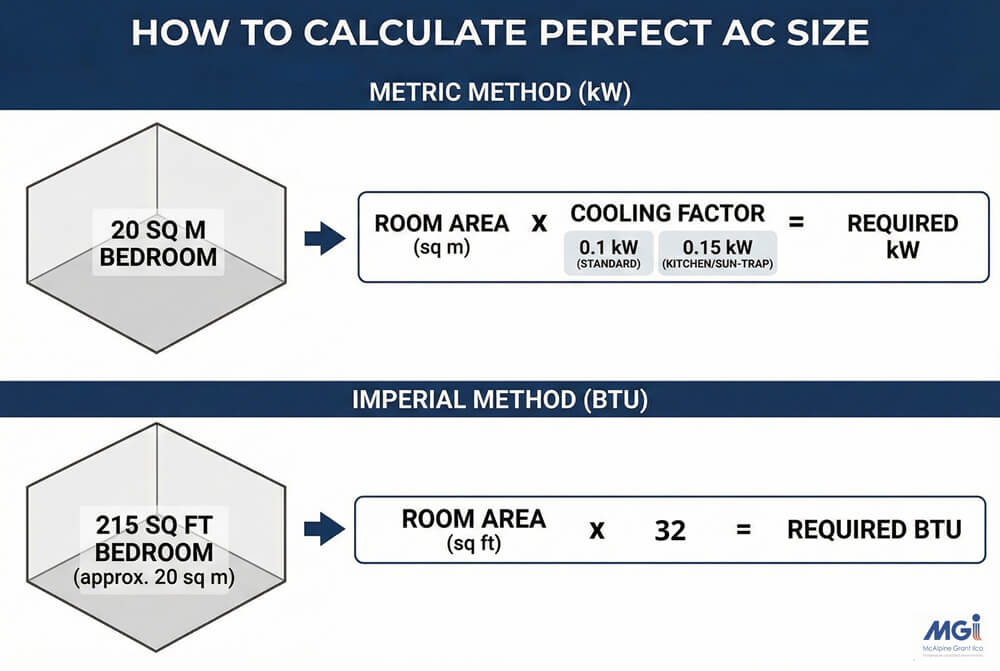
How to calculate the perfect AC size using a formula
Calculating your required cooling capacity involves a simple formula using your room’s measurements and a specific multiplier. You need to determine the required output in Kilowatts (kW) or British Thermal Units (BTU) to choose a model that matches your space.
Most air conditioners in the UK display their power rating in kW, but you will frequently see BTU on portable units or imported models. These are simply different measures of the same cooling “muscle” . One kilowatt equals approximately 3412,14 BTUs . You should be familiar with both numbers to compare units accurately across different brands.
The calculation formula
To find the baseline power you need, multiply your room’s floor area by the cooling factor required for your specific space.
- Metric method (kW): Multiply the room area in square metres by 0.1 kW for standard rooms or 0.15 kW for kitchens and sun-traps.
- Imperial Method (BTU): Multiply the room area in square feet by 32 for standard rooms, or 48 for kitchens/sun-traps.
For example:
Let’s say you need to cool a 20-square-metre bedroom. Using the metric formula, you multiply 20 by 0.1, giving you a requirement of 2.0 kW. If you are looking at a unit rated in BTUs, you multiply 2.0 kW by 3,412, which equals roughly 6,824 BTU. In this case, you would purchase a standard 7,000 BTU or 2.0 kW unit. For better cost calculations depending on the type of the room, use our air conditioning cost calculator.
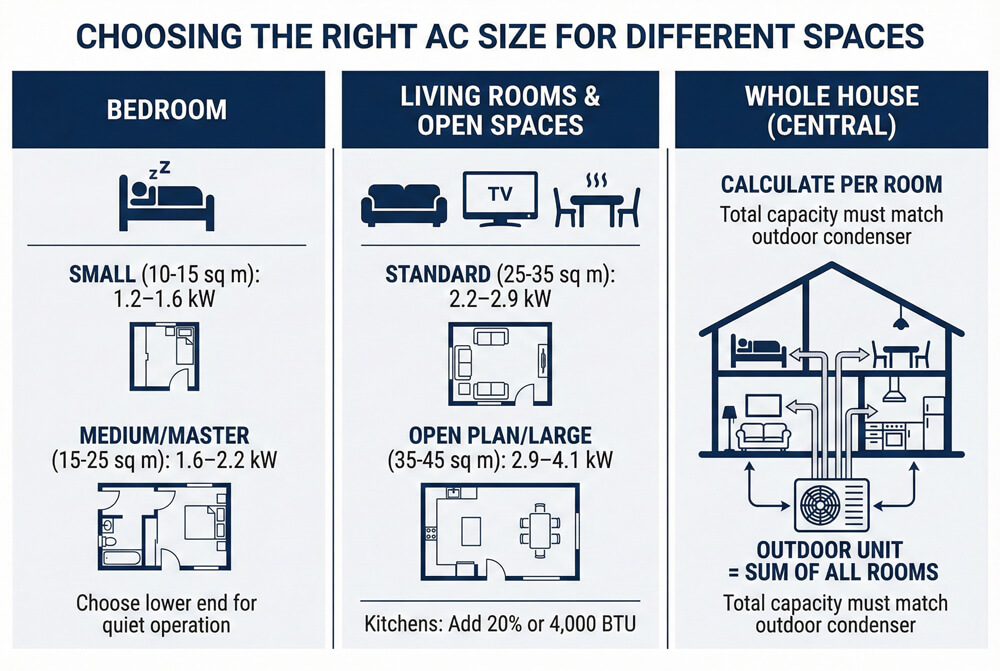
Choosing the right air conditioner size for different spaces
If you prefer a quick estimate over manual calculations, you can use general sizing standards based on typical UK room dimensions. These ranges assume standard insulation and ceiling heights, so simply move to the next size up if your room faces south or has large windows .
What size air conditioner do I need for my bedroom?
Most UK bedrooms fall into the small to medium category and require a unit between 1.2 kW and 2.5 kW. For a small bedroom or home office around 10 to 15 square metres, a 1.2–1.6 kW unit is usually sufficient. If you have a larger master bedroom between 15 and 25 square metres, look for a unit in the 1.6–2.2 kW range. You should stick to the lower end of the power scale for bedrooms to ensure the unit runs quietly and maintains a stable sleeping temperature.
Living rooms and open spaces
Living areas are generally larger and often have higher occupancy, requiring more powerful units to handle the increased heat load. For a standard lounge or dining area of 25 to 35 square metres, you will need a capacity between 2.2 kW and 2.9 kW . If you have a large open-plan space or a room between 35 and 45 square metres, you should opt for a 2.9–4.1 kW system. Remember that kitchens generate significant internal heat from appliances, so you must increase the capacity by approximately 20% or add 4,000 BTU for these spaces .
What size central air conditioner do I need for my house?
Sizing a central or multi-split system requires calculating the individual cooling load for each specific room rather than estimating a single number for the entire building. You cannot simply install one massive unit to cool multiple separate rooms unless they are completely open-plan, as airflow will not circulate through closed doors. For a whole-house solution, you must add up the required kW for every room you intend to cool and choose an outdoor condenser unit that matches this total capacity.
FAQ: common questions about air conditioner sizing
What happens if the AC is too big for the room?
An oversized air conditioner will cool the room down incredibly quickly, but it will then switch off before it has had time to dehumidify the air. This “short-cycling” process creates a room that feels cold yet clammy and uncomfortable. Additionally, the unit will consume excessive energy by constantly starting and stopping, which drives up your electricity bills.
Will an air conditioner break if the room is too big?
No, the air conditioner itself will not break because the room is large, but it will be undersized for the space, which leads to mechanical failure over time. If a small unit tries to cool a large room, it must run continuously at maximum power without ever resting. This constant strain causes components to overheat and wear out prematurely, significantly shortening the lifespan of your equipment.
Is it better to undersize or oversize AC?
You should aim for accuracy, but if you must choose between the two, slight oversizing is generally safer than undersizing. An undersized unit will simply fail to cool the room during a heatwave, leaving you hot and frustrated while still costing money to run. However, drastic oversizing is equally problematic, so try to stay within 10% of your calculated requirement.
How do I know if my AC is too small?
The most obvious sign is that the unit runs non-stop but the room never reaches the desired temperature. You may also notice that the air coming from the vents is cool, but the room remains warm, or your energy bills are disproportionately high for the amount of cooling you are getting. If the unit struggles to cope on particularly hot days, it is likely undersized for your specific heat load.
Do portable ACs need different sizing?
Yes, portable air conditioners are generally less efficient than wall-mounted split systems because they generate waste heat inside the room that must be vented out. As a result, you typically need a more powerful portable unit to achieve the same cooling effect as a fixed unit. You should add approximately 10–15% to your calculated BTU or kW requirement when shopping for a portable model to compensate for this efficiency loss.
Final word
Choosing the correct air conditioner size is the single most important step in ensuring your home stays comfortable during summer heatwaves. Taking five minutes to measure your room and calculate the required kW or BTU can save you from years of high energy bills and poor performance. Whether you need a small unit for a home office or a powerful system for an open-plan living area, always base your decision on data rather than guesswork.
If you need any help with the calculations or AC installation then our team is always happy to assist you. Contact us today or book a survey.